Search

Anthony Bailey
A new technology could help Louisiana producers save money by regulating the amount of seeds, fertilizer and other inputs they apply to their crops.
In recent years, variable rate technology, or VRT, has been developed and improved by LSU AgCenter researchers. Its primary purpose has been dispersing nitrogen fertilizer in sugarcane and rice fields, but researchers envision many more uses in the future.
Brenda Tubaña, department chair of the AgCenter School of Plant, Environmental and Soil Sciences, said the technology can provide farmers with a chance to be more cost-efficient with their nitrogen fertilizer applications.
“If we can demonstrate that we can apply less nitrogen fertilizer without reducing yield using this technology on a farmer’s own field, I think this becomes more convincing to them,” Tubaña said. “The idea is we can cut expenses for nitrogen fertilizer that will not make any yield benefits anyways, right? You only need to change fertilizer application method.”
Tubaña’s team built a mobile VRT applicator and sensor system in 2025. It is a complete system consisting of sensors, flow rate controller, applicator rig, GPS antenna and computer that can be easily attached to a farmer’s tractor. The sensor reads plant health and the formula in the computer system converts the reading to the amount of nitrogen needed, and the flow rate controller changes the application rate while the VRT rig is running.
This technology can also be applied to other agricultural inputs, like herbicides or lime, but nitrogen fertilizer is among the most used inputs applied via VRT because of its large impact on crop yield and expense. As the most expensive nutrient input, managing it efficiently is important to a farm’s success.
While there are potential financial benefits for farmers to use and have this technology on their farms, VRT is yet to be widely adopted commercially. Farmers may be hesitant to use a tool that they aren’t familiar with and, on top of that, putting together a system of their own won’t be cheap, Tubaña said.
To combat this hesitance, Tubaña and her team have brought the technology to farmers for a test drive on their own land to provide them with information on how much fertilizer they could save by not just applying the amount suggested on the fertilizer’s label. Tubaña says the tests have helped provide the researchers with more information for their sensors, and it also provides the farmers a chance to see for themselves how much they can save as well as the relative ease of attaching it to their tractor.
“We have had eight or nine growers join us inside the tractor with my students, which is a good thing,” Tubaña said. “When you have growers in the tractor seeing how the system works and with the digital display, showing real time application of variable rates of nitrogen, such experience is more engaging and perhaps an effective hands-on training for the farmers, I would say.”
Farmers have an option to use sensor-based nitrogen recommendations without using a VRT applicator from these test drives. Here, the sensor readings are averaged and converted to a uniform rate of nitrogen, thus the recommendation still is based on the need of the crops. This provides farmers with a chance to lower their rates of application using their own fertilizer applicator so that they don’t need the technology on their property all the time.
So far, Tubaña and her team have gone to 12 sugarcane farms and three rice farms this year. On the cane farms, VRT has shown that farmers could save on their fertilizer on all but one property. For Tubaña, this shows the potential significance VRT may have on Louisiana farms.
“Knowing that we have a technology capable of applying nitrogen on a need basis, it has become like a mantra to me: You don’t have to spend that much on nitrogen inputs, just implement a technology that can apply the right rate of nitrogen where it is needed in the field without hurting the yield,” Tubaña said. “It could be yield neutral, and in many cases yield positive, overall producing more with less nitrogen inputs mean greater returns.”
Anthony Bailey is a writer in AgCenter Communications.
This article appears in the summer 2026 edition of Louisiana Agriculture.
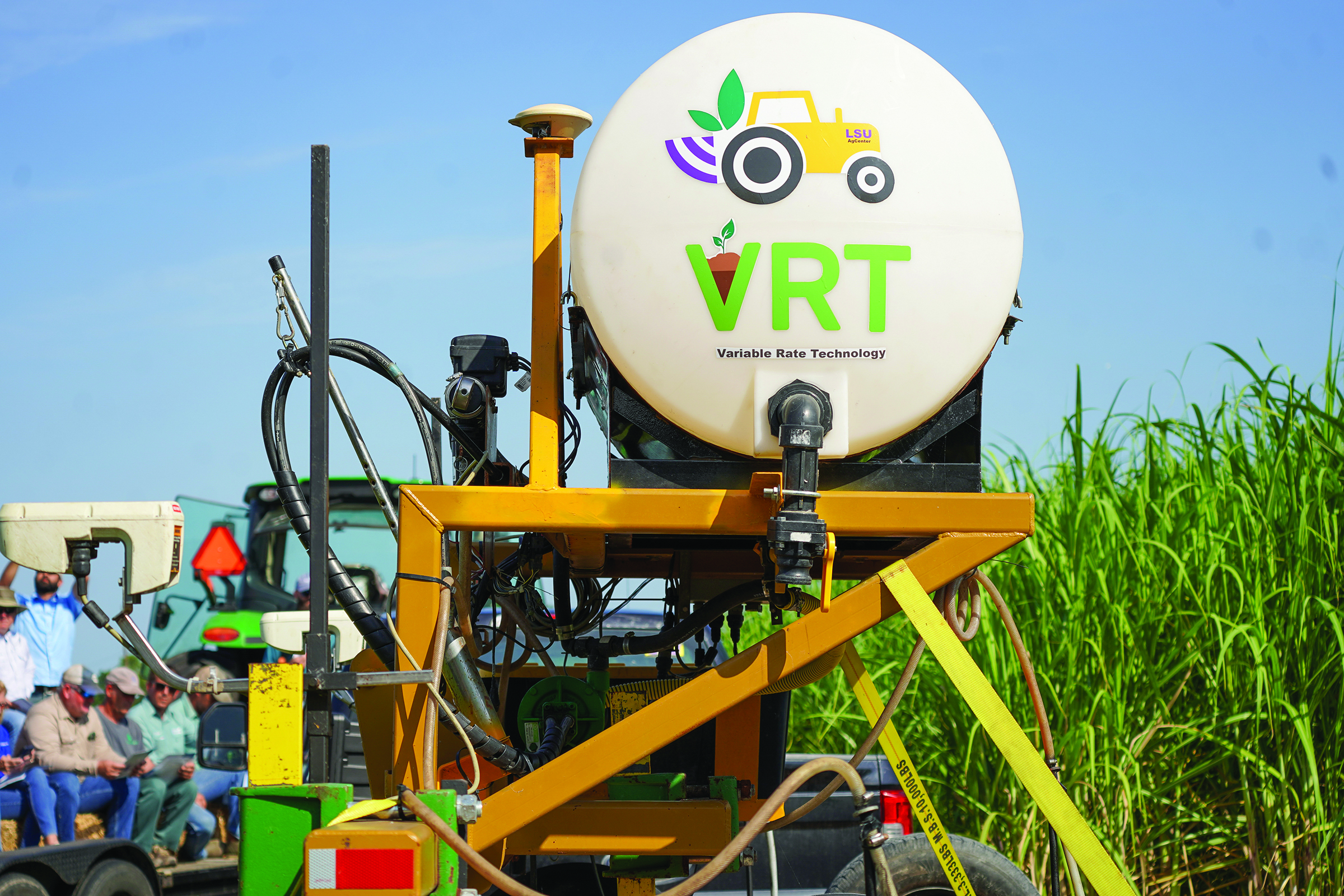
Brenda Tubaña’s team built a mobile variable rate technology applicator and sensor system that consists of sensors, a flow rate controller, applicator rig, GPS antenna and computer that can be easily attached to a farmer’s tractor. The sensor reads plant health and the formula in the computer system converts the reading to the amount of nitrogen needed, and the flow rate controller changes the application rate while the VRT rig is running. Photos by Anthony Bailey

Brenda Tubaña is one of the LSU AgCenter’s top researchers in the field of variable rate technology, and she helps teach producers and AgCenter Extension agents about the technology. Photo by Anthony Bailey