Search

All the talk this time last year was about the incredible run through the fall selling season. We’ve hit the inverse this year with prices falling here in the last month to 6 weeks. Input costs continue to be a concern and right now pulling up to the diesel pump to fill your trucks and tractors is about as pleasant as a trip to the dentist. It is easy to focus on the present and some of the issues right in front of us. Don’t let that gloss over what an incredible year it has been. Within the last 12 months, you’ve sold cattle for as high as they’ve ever been. The weather has mostly cooperated and pastures have been good. The cows that I’ve looked at have been in good shape, and almost everyone I’ve talked with has weaned heavy calves. I think it is pretty safe to mark this past year down in the good category.
Our Annual Livingston Fall Beef Meeting is scheduled for the afternoon of October 24th. Danny and Lisa Aydell will host us this year down in French Settlement. I’ll send out more details later but please mark it down on your calendar.
We started a youth component a couple of years ago that has been really fun. The feedback from that was tremendous and we will once again do that on the same day in the morning. We are targeting any junior high and high schoolers that have an interest in beef production so please help spread the word when the flyer goes out.
I based my calculations on a medium fertility requirement of 50-60-60 for nitrogen, phosphorus, and potassium. I used urea along with diammonium phosphate and muriate of potash as the bulk fertilizer ingredients. This fertilizer rate is the same rate I use on a yearly basis to track costs. As always pull a soil sample and see what your needs will be. The seed cost is based on the more popular tetraploid varieties and planted at a rate of 40 pounds to the acre. The estimated cost to plant is somewhere around $134 this year. The figured costs are going to have some fluctuations. The costs are reflective of a survey of prices from suppliers during the same time frame each year. The initial costs are right on from last year. Fertilizer prices have remained elevated and don’t show a whole lot of promise in coming down drastically in the short term.
| Crop | Varieties |
| Tall Fescue (Grasses) | Jesup Max Q, Kentucky-31 |
| Oats (Grasses) | Gladiator, Maximus. The variety Hot Shot is considered as promising. |
| Cereal Rye (Grasses) | Elbon, Maton, Maton II, Oklon, Wintergrazer 70 |
| Annual Ryegrass (Grasses) | Bashaw Tetraploid, Earlyploid, Gulf, Herdsman, Lagniappe Tetraploid, MORE Tetraploid, Prine, Rio |
| Wheat (Grasses) | SSI 30-06 |
| Triticale (Grasses) | FL 08128 |
| Alfalfa (Legumes) | No commercial varieties have been tested in recent years. |
| Arrowleaf Clover (Legumes) | Amclo, Meechi, Yuchi, Apache |
| Balansa Clover (Legumes) | FIXatioN |
| Berseem Clover (Legurnes) | Bigbee, Frosty |
| Crimson Clover (Legumes) | Chief, Dixie, Tibbee, AU Robin |
| Red Clover (Legumes) | Kenland, Kenstar, Cherokee, Southern Belle, AU Red Ace, Barduro |
| Subterranean Clover (Legurnes) | No Commercial varieties have been tested in recent years. |
| White Clover (Legumes) | LA S-1, Osceola, Regalgraze, Pinnacle, Durana, Neches, Renovation, Cresendo, Stamina |
| Ball Clover (Legumes) | Grazer's Select, Don |
| Entry | Franklinton | Jeanerette | 3-Year Mean |
| MORE Tetraploid (Commercial Varieties) | 9,508 | 7,940 | 8,724 |
| Wax Marshall (Commercial Varieties) | 8,895 | 8,136 | 8,515 |
| Rio Cana (Commercial Varieties) | 8,829 | 7,751 | 8,290 |
| Lagniappe Tetraploid (Commercial Varieties) | 8,583 | 7,663 | 8,123 |
| Bashaw Tetraploid (Commercial Varieties) | 8,569 | 7,512 | 8,041 |
| Prine (Commercial Varieties) | 8,351 | 7,409 | 7,880 |
| Gulf (Commercial Varieties) | 8,184 | 7,505 | 7,844 |
| Herdsman (Commercial Varieties) | 8,025 | 7,358 | 7,691 |
| EarlyPloid (Commercial Varieties) | 8,111 | 7,255 | 7,683 |
| Jackson (Commercial Varieties) | 7,661 | 7,458 | 7,560 |
| Tetrastar Tetraploid (Commercial Varieties) | 7,897 | 7,112 | 7,504 |
| Nelson Tetraploid (Commercial Varieties) | 7,807 | 7,136 | 7,472 |
| WMWL-2 (Experimental Varieties+) | 9,878 | 8,624 | 9,251 |
| ME-4 (Experimental Varieties+) | 8,956 | 8,293 | 8,624 |
| WMWL (Experimental Varieties+) | 8,352 | 7,948 | 8,150 |
| ME94 (Experimental Varieties+) | 8,094 | 7,650 | 7,872 |
| Mean | 8,481 | 7,672 | 8,077 |
| SE++ | 520 | 217 | 199 |
+Entries are experimental and not commercially available.
++Standard error
| Crop | Seeding Rate (lb/A) Planted Alone | Seeding Rate (lb/A) Planted in Mixture |
| Tall Fescue (Grasses) | 30 | 20 |
| Oats (Grasses) | 100 | 60 |
| Cereal Rye (Grasses) | 90 | 50 |
| Annual Ryegrass (Grasses) | 30 | 20 |
| Wheat (Grasses) | 90 | 60 |
| Alfalfa (Legumes) | 20-30 | - |
| Arrowleaf Clover (Legumes) | 8 | 5 |
| Balansa Clover (Legumes) | 5-8 | 4 |
| Berseem Clover (Legumes) | 20 | 15 |
| Crimson Clover (Legumes) | 15 | 12 |
| Red Clover (Legumes) | 12 | 8 |
| Subterranean Clover (Legumes) | 15 | 12 |
| White Clover (Legumes) | 5 | 3 |
| Ball Clover (Legumes) | 5 | 3 |
| Crop | Prepared Seedbeds Planting Dates | Sod Planting Dates |
| Tall Fescue (Grasses) | Sept. 20-Oct. 15 | --- |
| Oats (Grasses) | Sept. 1-Oct. 15 (N LA) Sept. 15-Oct. 15 (S LA) | Approx. Oct. 15 |
| Cereal Rye (Grasses) | Sept. 20-Oct. 15 | Approx. Oct. 15 |
| Annual Ryegrass (Grasses) | Sept. 20-Oct. 15 | Approx. Oct. 15 |
| Wheat (Grasses) | Sept. 20-Oct. 15 | Approx. Oct. 15 |
| Alfalfa (Legumes) | Oct. 5-Oct. 20 | --- |
| Arrowleaf Clover (Legumes) | Oct. 1-Nov. 15 | Oct. 15-Nov. 15 |
| Balansa Clover (Legumes) | Oct. 1-Nov. 15 | Oct. 15-Nov. 15 |
| Berseem Clover (Legumes) | Oct. 1-Nov. 15 | Oct. 15-Nov. 15 |
| Crimson Clover (Legumes) | Oct. 1-Nov. 15 | Oct. 15-Nov. 15 |
| Red Clover (Legumes) | Oct. 1-Nov. 15 | Oct. 15-Nov. 15 |
| Subterranean Clover (Legumes) | Oct. 1-Nov. 15 | Oct. 15-Nov. 15 |
| White Clover (Legumes) | Oct. 1-Nov. 15 | Oct. 15-Nov. 15 |
| Ball Clover (Legumes) | Oct. 1-Nov. 15 | Oct. 15-Nov. 15 |
This material was prepared by the following personnel of the LSU AgCenter:
Dr. Ed Twidwell, Professor, School of Plant, Environmental and Soil Sciences
Dr. Kun-Jun Han, Associate Professor, School of Plant, Environmental and Soil Sciences
Dr. Charles Hutchison., Associate Professor, Southeast Research Station
Dr. Jose Pereira Neto, Assistant Professor, Macon Ridge Research Station
Greg Williams, Research Associate, Iberia Research Station
Jerry Simmons, Research Associate, Southeast Research Station
Shannon Forbes, Research Associate, Southeast Research Station
Dr. Kurt Guidry, LSU AgCenter
Over the past couple of months, cattle markets have been confronted with several developments that have increased both uncertainty and volatility. The typical seasonal downturn in beef demand during the hottest part of the summer appears to have been more pronounced and longer lasting than normal, as extreme temperatures contributed to a significant summer slowdown in beef movement. As a result, carcass cutout values declined, eventually placing pressure on both fed cattle and feeder cattle prices.
Several subsequent announcements added more uncertainty to an already volatile market environment.
The first was the reopening of the border to Mexican cattle on August 24. However, only one port initially reopened, and USDA reports indicated weekly imports of just 1,900 to 2,500 head. As discussed in last month's newsletter, the total number of cattle likely to be imported during the remainder of 2026 is estimated at only 200,000 to 300,000 head. While those additional cattle are unlikely to significantly alter the fundamentally tight cattle supply situation, they do add another layer of uncertainty and have contributed to increased market volatility.
The next development involved continued packing plant closures. These closures have largely been a response to declining packer margins and limited cattle supplies. Many costs associated with packing operations are fixed, so when plants operate below capacity, costs per animal increase and profitability declines. Combined with weaker carcass cutout values earlier this summer, these economic pressures have led some packers to consolidate operations, shifting cattle to other facilities in an effort to improve operating efficiency.
In the short term, these closures are not expected to have a major impact on cattle markets. In fact, improved efficiency could allow packers to become more aggressive in sourcing limited cattle supplies, potentially providing support to fed cattle prices. Longer term, however, any reduction in processing capacity deserves attention. Given current cattle inventories, the industry likely has more processing capacity than is immediately needed. The question is what happens when cattle numbers eventually begin to expand. Will sufficient processing capacity be available and operational when larger cattle supplies return? Those questions remain unanswered and will only be resolved over time. For now, the market impact appears limited.
The third major announcement came from President Trump regarding the importation of 300,000 metric tons of lean beef trimmings for ground beef production without tariffs. The key question is how this action may affect beef and cattle markets.
At this point, the answer is unclear because significant details remain unknown. For example, will these imports simply replace volumes that would have entered the country under existing tariff rate quota programs, or will they represent additional beef entering the market beyond normal import levels? The answer to that question is critical in determining potential market impacts.
Many economists have suggested that this action will have little effect on retail beef prices paid by consumers. However, its implications elsewhere in the supply chain are worth examining. Imported lean trim must still be blended with trimmings generated from cattle harvested in the United States. Therefore, this action does not appear likely to significantly reduce the need for domestic cattle slaughter. Likewise, because it does not increase available cattle supplies, it is difficult to envision a major long-term impact on fed cattle prices.
That said, the market reaction has been negative. This announcement has come at a time when cattle markets were already facing pressure from weaker beef values, uncertainty surrounding Mexican cattle imports, and concerns regarding packing plant capacity. Whether this reaction ultimately proves to be an overcorrection, similar to market responses following previous import announcements involving Argentina, remains to be seen. Nevertheless, when combined with the other issues currently affecting the market, it has clearly added to uncertainty and volatility.
| Report Date | Current Report | Previous Report | Last Year Report | |
| 500 - 600 Lbs. MS Auctions Joplin Auction OKC Auction Superior | 8/24/2026 8/24/2026 8/24/2026 8/17/2026 | $347.81 $374.88 $387.46 $397.61 | $361.15 $402.54 $398.74 $417.70 | $373.34 $398.91 $428.20 $431.99 |
| 700 - 800 Lbs. MS Auctions Joplin Auction OKC Auction Superior | 8/24/2026 8/24/2026 8/24/2026 8/17/2026 | $308.67 $327.85 $323.35 $350.54 | $314.09 $318.14 $340.94 $372.10 | $312.71 $363.38 $355.32 $373.23 |
| Fed Steers National Direct | 8/23/2026 | $224.97 | $228.04 | $244.31 |
| Beef Prices Choice Cutout All Fresh Retail | 8/22/2026 Jul-26 | $388.27 $975.30 | $373.24 $964.30 | $406.61 $890.30 |
At the same time, carcass cutout values have begun to show some improvement ahead of the stronger beef demand that typically accompanies the Labor Day holiday period. However, fed cattle and feeder cattle markets have continued to struggle to find support and have generally trended lower over the past month. Calf and feeder cattle prices continue to face pressure, with recent market reports showing prices below the previous week and, for the first time in quite some time, below levels reported during the same period in 2025. One notable exception has been retail beef prices, which have generally remained above year-ago levels.
With so many headlines weighing on the market, it is easy to lose sight of the fact that the fundamental supply-and-demand conditions supporting cattle prices have not changed significantly. Cattle supplies remain historically tight and could become even tighter if ongoing heifer retention efforts continue to reduce the number of females entering the beef supply chain.
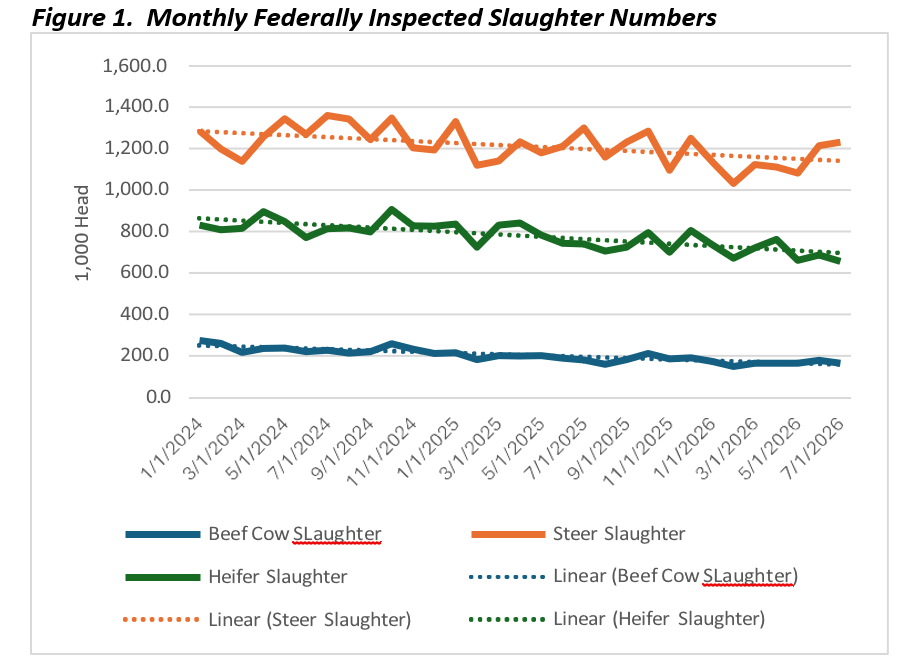
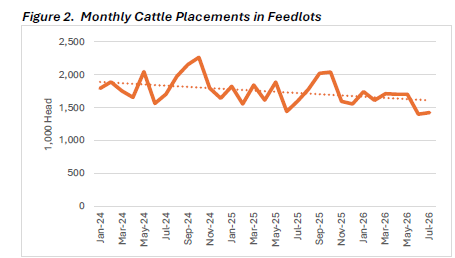
While cattle-on-feed inventories have increased compared to a year ago, this should not be interpreted as evidence of growing cattle supplies. Rather, it reflects fewer marketings from feedlots and longer feeding periods that are keeping cattle on feed longer. Meanwhile, cattle slaughter numbers continue to decline. Taken together, these indicators suggest that the underlying supply situation remains supportive of cattle prices and that the tight supply environment that has characterized the market over the past several years remains intact.
However, there is likely enough uncertainty in the marketplace to limit upside price potential in the short term. These factors, combined with the normal seasonal decline in calf and feeder cattle prices that occurs each fall, suggest there is a reasonable possibility that the market highs for 2026 have already been established. This does not imply a major price collapse is coming. Rather, it suggests that prices may struggle to revisit the record highs experienced during the spring and early summer months.
Looking beyond this year, there is still considerable evidence supporting favorable cattle prices. In its August Cattle Outlook Report, USDA slightly reduced its forecast for average annual cattle prices in 2026 but maintained its expectation that average prices in 2027 will exceed those of 2026. In other words, USDA continues to project higher prices moving forward, although the pace of those increases is expected to be slower than what producers have experienced in recent years.
| May-26 | Jul-26 | Aug-26 | |
| 2026 Projections Fed Steers ($/Cwt) Feeder Steers ($/Cwt) Cull Cows ($/Cwt) | $249.66 $377.22 $162.50 | $251.10 $376.26 $161.07 | $245.35 $367.76 $159.07 |
| 2027 Projections Fed Steers ($/Cwt) Feeder Steers ($/Cwt) Cull Cows ($/Cwt) | $253.75 $382.00 $163.75 | $254.25 $382.00 $166.25 | $249.25 $373.75 $166.25 |
| Percent Change (2025 - 2026) Fed Steers ($/Cwt) Feeder Steers ($/Cwt) Cull Cows ($/Cwt) | 11.27% 17.20% 14.30% | 11.91% 16.90% 13.29% | 9.35% 14.26% 11.89% |
| Percent Change (2026 - 2027) Fed Steers ($/Cwt) Feeder Steers ($/Cwt) Cull Cows ($/Cwt) | 1.64% 1.27% 0.77% | 1.25% 1.53% 3.22% | 1.59% 1.63% 4.51% |
In summary, optimism regarding cattle prices remains justified, but the level of uncertainty and volatility confronting cattle markets has clearly increased. While the longer-term trend still points toward relatively strong prices, producers should expect periodic corrections and price pullbacks along the way. Staying informed about market developments will be increasingly important when making marketing decisions. Given the heightened volatility, producers may also want to carefully evaluate available risk management tools and strategies to help protect against downside price risk while preserving opportunities to benefit from future market strength.
Bobby Bingham
ANR Agent - Livestock
Livingston Parish
Website: www.lsuagcenter.com/beefcattle
YouTube: LSU AgCenter - Livestock
Facebook: @LSUAgCenterBeefCattle
Instagram: @LSU_agcenter_beef_cattle
Twitter: @BeefLSU