Search
David Moseley, Davis, Jeff A., Hendrix, James, Kerns, Shelly, Orfanou, Anna, Pavlou, Dimitrios, Ippolito, Stephen, Price, Randy R., Padgett, Guy B., Price, III, Paul P, Miller, Donnie K., Olson, Gregory, Castro, Saulo, Jha, Prashant, Vieira, Leandro, Villegas, James M., Gauthier, Ted

Shelly Kerns, Boyd Padgett, and Trey Price, LSU AgCenter Scientists
There has been an abundance of ear rots reported in Louisiana throughout this growing season. As the harvest window is winding down, and with many growers already finished with harvest, I have heard of one reoccurring issue in particular: aflatoxin. There have been reports of heavy docking and even loads being rejected at the elevators. In addition to this, there are now many growers who are planning to store their grain who have been inquiring about storage guidelines for infected grain. Overall, there have been many questions about why aflatoxin levels have been so high this year. Below is a summary of aflatoxin development/production and recommendations for storing infected grain.
Aflatoxin is a mycotoxin, meaning that it is a toxic chemical produced by fungi. Aflatoxin can only be produced by two species of Aspergillus that are plant pathogenic (A. flavus and A. parasiticus). Aspergillus primarily presents in infected corn plants as an ear rot pathogen. Ears with Aspergillus ear rot will exhibit as a fuzzy or felt-like olive-green mold (image 1). It is important to note that just because an ear is infected does not mean the fungus will produce aflatoxin. It is only when corn plants enter severe stress that the fungal pathogen can be triggered to start producing the mycotoxin.
Aflatoxin production is historically associated with high heat, severe drought, and high humidity. Our growing season had a substantial wet period, and because of this, there has been confusion on why aflatoxin presence has been so bad this year. Aspergillus overwinters in the soil. Rainfall created the perfect environment for spread of fungal spores. Raindrops can splash spores from soil to plants within a field, and wind can also pick up spores and disperse them further. Once the rainfall subsided, spores were most likely able to start germinating and infecting plants. Aspergillus spores can infect through the silks during the late silking stage, or through wounds caused by physical environmental injury or insect feeding. As the season progressed and the weather became extremely dry, this probably triggered Aspergillus to start producing aflatoxin.
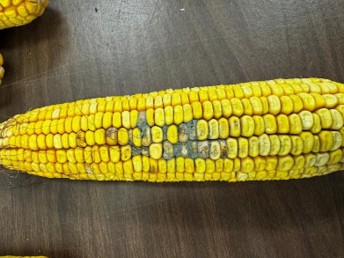
Figure 1. A corn ear from the Avoyelles parish corn core block displaying “fluffy” olive-green Aspergillus ear rot.
David Moseley, LSU AgCenter Soybean Specialist
The 2026 Louisiana soybean growing season included several weather extremes that may affect yield. The amount of any yield loss will be difficult to determine until harvest because crop response varies with growth stage, soil type, drainage, irrigation, and other management practices. In addition, statewide and regional weather summaries do not capture the conditions experienced in every field.
Four major weather-related events or patterns affected Louisiana soybean production during 2026: a freeze on March 17, above-average temperatures during March and April, excessive rainfall and flooding during May and June, and hot and dry conditions in July and August.
Figure 1 shows that 75% of the Louisiana soybean crop was planted by April 25, approximately 13 days earlier than the five-year average date of May 8. This early planting probably contributed to the earlier occurrence of subsequent developmental milestones. Statewide, the 75% dates for beginning bloom, pod set, and beginning color occurred approximately 11 to 14 days earlier than their respective five-year averages. Above-average maximum and minimum temperatures during March and April may have further accelerated soybean growth and development (Figure 2).

Figure 1. Estimated dates when 75% of Louisiana soybean acreage reached selected developmental milestones during 2026 compared with the five-year average. Source: USDA-NASS.
The March 17 freeze damaged some of the earliest-planted soybean fields in Louisiana. Observed injury included damage to unifoliate leaves and the apical meristem. However, many affected plants recovered by producing axillary branches from lower nodes. The statewide impact of the event was limited because only approximately 1% of Louisiana soybean acreage had been planted when the freeze occurred.
Excessive rainfall during May and June created saturated soil conditions in many fields and caused severe flooding in portions of central Louisiana (Figure 2). Rainfall associated with Tropical Storm Arthur was especially intense in the central Louisiana region, where approximately 30 inches of rainfall in less than 12 hours was reported. Preliminary assessments indicated that approximately 114,000 soybean acres were affected by the flooding. Nearly 38,000 acres were considered complete crop losses, while persistent wet conditions prevented the planting of an additional 15,000 acres. Many surviving fields experienced partial stand loss or other injuries that could reduce yield and profitability. Total economic losses to Louisiana soybean production were estimated at approximately $33 million, based on an LSU AgCenter damage assessment.
Nighttime temperatures during June and July were generally above their recent averages. Warm nighttime conditions can increase plant respiration and the use of carbohydrates produced through daytime photosynthesis. This inefficient use of energy by the plant can reduce yield; however, the effect of the higher-than-average temperatures could have been mitigated by the adequate soil moisture by supporting transpiration and evaporative cooling. Therefore, frequent rainfall during May and June may have moderated heat stress in fields with adequate drainage. In poorly drained or flooded fields, however, the benefits of available water were likely outweighed by oxygen deficiency and impaired root function. Heat and saturated soil conditions can interact because warm temperatures increase plant and microbial oxygen demand in already oxygen-limited soils.
In July and August, rainfall was below and the maximum temperature was above the 2020–2025 average in Chase and Alexandria, LA. The potential consequences of higher heat and drying pattern differed among fields because soybean development was early in 2026. Soybeans planted during the early and middle portions of the recommended planting window were generally farther along in seed fill or beginning to mature, whereas later-planted fields could still have been at growth stages that were more susceptible to heat and drought stress.

Figure 2. Monthly average maximum and minimum air temperatures and total rainfall at Chase, LA during 2026 compared with the 2020–2025 averages. Source: Louisiana Agriclimatic Information System.
Leandro O. Vieira, Ted Gauthier & Gregory Olson, LSU AgCenter Soil Testing Lab Scientists
The LSU AgCenter has published two new factsheets about the importance of soil testing: Don't guess: Soil Test! and about the Importance of Proper Soil Sampling. These factsheets offer guidance on what should be taken into account when soil sampling and on why soil testing is still the foundation of a cost-effective fertilization program.
Donnie Miller, Stephen Ippolito, and Dr. Prashant Jha, LSU AgCenter Weed Scientists
Italian ryegrass has become a serious problem for Louisiana producers and if left uncontrolled can reduce crop yield. Ryegrass is currently the most troublesome winter species in corn, cotton, and soybean. If growers can’t control the grass, it becomes a tremendous competitor with crops, especially those planted early, such as corn, which reduces yield for producers. The weed may also host insect populations, which is doubly problematic. Often, attention is not focused on later-emerging spring populations or earlier misses in control until it’s too late. The size of later-emerging spring populations or earlier missed ryegrass, along with resistance development to once effective postemergence herbicide options, limits effective control at that time.
Research initiated in fall of 2022 and expanded in fall of 2023 and 2024 has shown that the use of cover crops and/or soil residual herbicides applied in the fall after harvest can be effective tools in combatting spread. Cereal rye at a seeding rate of 80 pounds per acre can effectively compete with emerging ryegrass and limit tiller and seedhead production. Ryegrass tiller number reduction in both years was good to moderate (43 and 81%) in spring with only cereal rye planted in fall and reduced 50 and 45% with only S-metolachlor applied in the fall at 1.33 pints. The combination of the two, however, resulted in a 95 and 97% reduction by spring. Seedhead production was only significantly reduced by the combination (93%) in spring of 2024 but was reduced by the cereal rye (81%) and S-metolachlor (41%) in 2025 in addition to the combination treatment (97%).
A second part of this approach is identifying optimum timing for herbicide application in relation to cover crop and ryegrass emergence. Unfortunately, these species often emerge simultaneously, so having the herbicide out as early as possible is most beneficial. Research initiated in the fall of 2023 and repeated in 2024 has shown that some residual herbicides, such as S-metolachlor or pyroxasulfone, can be applied at the spiking stage (80% or greater cereal rye or black oat plants emerged through soil), while others such as metribuzin and clomazone are much better tolerated when applied two weeks after emergence to one- to two-leaf plants. Plant injury with these two herbicides, however, is greater than with S-metolachor and pyroxasulfone at this timing as well.
A non-injurious soil residual herbicide applied soon after cover crop emergence in fall offers producers an effective program for managing ryegrass during winter and spring months ahead of planting.I n addition to weed management, agronomic and soil benefits associated with cover crops are realized. This combination offers a one-two punch approach to ryegrass management, allowing the soil herbicide to eliminate or limit emergence of ryegrass during late fall and early winter months while the cover crops limit spring emergence and competition from plants not controlled in fall due to prolific biomass production in spring.
To control emerged Italian ryegrass that may have escaped control from fall applied residual herbicides, an application can be made in the spring. Research conducted in 2024 and 2025 found that application of glufosinate or paraquat provided 89 or 95% control of Italian ryegrass at the anthesis reproductive growth stage, respectively. In addition, application at anthesis with glufosinate or paraquat, reduced Italian ryegrass seed viability by 20 or 32%, respectively.
Ryegrass control four weeks prior to soybean planting in spring with a cereal rye cover crop treated over-the-top with Dual Magnum (S-metolachlor) two weeks after emergence in the fall. Photo by Donnie Miller

Ryegrass population four weeks before soybean planting with no treatment or cover crop used in the fall. Photo by Donnie Miller

Stephen Ippolito, Donnie Miller, and Prashant Jha LSU AgCenter Weed Scientists
With cotton and soybean harvest well underway, it is a good time to review options for controlling glyphosate-resistant johnsongrass post-harvest. While the goal of all producers is to control weeds in-crop to minimize yield impact, it is also important to utilize control measures post-harvest for long term perennial weed management.
Post-harvest options for controlling glyphosate-resistant johnsongrass are limited, with the primary means of control coming from glufosinate or Group 1 herbicides (clethodim, quizalofop, fluazifop). Due to their chemical nature as weak acid herbicides, water source issues such as “hard water’ or high pH can significantly reduce Group 1 herbicide efficacy, therefore addition of AMS and/or water conditioners can be of great benefit under these conditions. Herbicide label also recommends use of NIS or COC. All group 1 herbicides can be co-applied with glyphosate or glufosinate. However, it is important to remember that antagonism may occur when co-applying Group 1 herbicides with products which primarily have broadleaf control, including Group 2 herbicides, 2,4-D, or dicamba (Group 4). The general rule of thumb is to apply Group 1 herbicides at least 3 days prior to or 7 days after applying potentially antagonistic herbicides. If you do decide to co-apply a Group 1 herbicide with a potentially antagonistic herbicide, applying at the maximum labeled rate for the grass species of interest may help to overcome potential antagonism. Co-application with paraquat may result in a significant reduction in control by Group 1 herbicides due to rapid desiccation of foliage. Preliminary data shows that tank mixtures of glufosinate with quizalofop or glufosinate followed by clethodim or quizalofop applied sequentially does provide excellent control of glyphosate-resistant johnsongrass in-crop. Reliance on any one mode of action may lead to the development of new herbicide-resistant johnsongrass populations.
Last, while not a popular option, johnsongrass can also be mowed to suppress growth and reduce development of seed heads. Regardless of method utilized, multiple applications may be needed to suppress johnsongrass until first frost. I would also like to emphasize the importance of cleaning equipment between fields as well as harvest order. Cleaning equipment after any activity in the field, especially tillage equipment, can help to prevent the spread of johnsongrass seed and rhizomes. More information about cleaning equipment and harvest order can be found at https://www.lsuagcenter.com/articles/page175823567... AgCenter weed scientists are working in collaboration with researchers from other universities to evaluate alternative methods to control johnsongrass post-harvest.
Randy Price, LSU AgCenter Agricultural Engineer
Sprayer drones are a new tool to apply pesticides and chemicals to farm fields and land areas. Still, these devices must be used with care to obtain good results. An area of great concern is ripener application in sugarcane. In this type of application, the sprayer drone settings and parameters must be set correctly to obtain best uniformity and coverage without doubling or causing skips, which can result in loss of TRS (total recoverable sugar) and damage to the field. The following guidelines are given to help ensure good ripener application with less chance for damage:
Uniform application is the key to high TRS levels and drones can do this well, but if done improperly, severe damage can occur to the field requiring replanting. If you have any questions about sprayer drone use or settings, contact Randy Price at: 225-936-7593 or [email protected].
Leandro O. Vieira, Saulo Castro, and David Moseley, LSU AgCenter Scientists
CEC stands for Cation Exchange Capacity, which is the ability of the soil to hold positively charged nutrients (cations). Most plant nutrients (essential elements) are positively charged, including nitrogen (as ammonium, NH₄⁺), potassium (K⁺), calcium (Ca²⁺), magnesium (Mg²⁺), zinc (Zn²⁺), copper (Cu²⁺), iron (Fe²⁺ or Fe³⁺), manganese (Mn²⁺), and nickel (Ni²⁺). For this reason, when considering the potential of a soil to hold nutrients for plants, CEC is very important. Nutrients held on exchange sites are less susceptible to leaching while remaining available for plant uptake.
There are two soil properties that have a major effect on CEC: soil texture and organic matter content. Basically, nutrients are held around soil particles. Because clay particles are much smaller than sand particles, a given volume of soil can contain far more clay particles than sand particles. Long story short, fine-textured soils with higher clay content generally have a higher CEC than coarse-textured soils with high sand contents.
An analogy that can be made is that a soil with more clay is like a truck with a large fuel tank, while a soil with more sand is like the same truck with a much smaller fuel tank (Figure 1). Therefore, sandier soils need to be refueled more often than clayey soils. In addition, because that "truck" can hold less fuel, it is very unlikely that there will be any benefit from applying fertilizer rates above recommendations on soils with high sand content.

Figure 1. The "soil's fuel tank" analogy illustrating cation exchange capacity (CEC).
Some producers prefer to build soil fertility by applying fertilizer above recommended rates, especially in years when commodity prices are favorable. However, it is important to remember that some soils can hold more nutrients than others. At the end of the day, relying on soil test results and applying fertilizer according to recommendations is generally the most cost-effective strategy. While building soil-test levels may be justified in certain situations, the soil's capacity to retain nutrients should always be considered when making those decisions.
Even though it is not possible to change the texture of our soil, we can still adopt strategies to increase/maintain organic matter in our soils. Organic matter particles are generally much smaller than clay and can also hold nutrients. Reduced tillage, cover cropping and organic amendment application are examples of strategies that can potentially improve the ability of our soil to store more nutrients for our crops.
James Hendrix and Anna Orfanou, LSU AgCenter Scientists
Winter Cover Crops/Legumes/Annuals
Anna Orfanou, James Hendrix and Dimitrios Pavlou, LSU AgCenter Scientists
With harvest underway and fall approaching, it is time to start thinking about winter cover crops. One of the first questions is also one of the most important: Which cover crop should I plant?
There is no single best cover crop for every field. The right choice depends on what you want the cover crop to accomplish, when it can be planted, and which cash crop will follow it. Winter cover crops used in Louisiana generally fall into two major groups: grasses, such as cereal rye, wheat and oats, and legumes, such as vetches, winter peas, and clovers. Each group brings different benefits and management considerations.
If your primary goals are maintaining soil cover, producing residue, scavenging nutrients, or suppressing weeds, a grass cover crop may be a good fit.
Cereal rye is a popular choice because of its winter hardiness and ability to produce substantial biomass. Its fibrous root system and aboveground residue help keep the soil protected during the winter and into the following growing season. Cereal rye can also take up residual nutrients that might otherwise be vulnerable to loss during Louisiana's wet winter and early spring months.
Wheat and oats are additional winter grain options. Like cereal rye, they can produce residue that contributes to ground cover and nutrient cycling. This can be particularly useful following crops such as soybean and cotton, which leave relatively small amounts of residue compared with crops such as corn.
More biomass, however, is not always better. Heavy grass residue can interfere with planting if it is not managed properly, and actively growing cover crops continue to use soil water. When choosing a grass, consider not only how much biomass you want but also how that biomass will be managed before planting the next crop.
If nitrogen contribution is one of your main goals, a legume may be a better option. Hairy vetch, winter peas, and clovers are among the legumes that can be used as winter cover crops in Louisiana.
Legumes, in partnership with nitrogen-fixing bacteria, can convert atmospheric nitrogen into forms incorporated into plant biomass. As the residue decomposes, a portion of that nitrogen can become available to the following crop.
Louisiana research has shown good biomass potential from hairy vetch and winter peas, as well as several clovers (Boquet, 2012). However, legumes need enough growing time to realize their nitrogen fixation potential, which makes planting date especially important.
Choosing a cover crop does not necessarily mean choosing only one species. Grass-legume mixtures can combine some of the benefits of both groups. A grass can provide dependable ground cover, biomass, and nutrient scavenging, while a legume contributes biologically fixed nitrogen.
The tradeoff is greater management complexity. Species differ in seed size, establishment, growth rate, maturity, and termination requirements. Before planting a mixture, consider what each species is expected to contribute rather than adding species simply to increase diversity.
It's also worth planning ahead for termination timing, not just planting date. Grasses and legumes break down at different rates and can call for different burndown windows ahead of your next cash crop, so decide early how and when you plan to terminate the cover crop you choose.
References:
Boquet, D. (2012). Winter cover crops (Chapter 2). LSU AgCenter Conservation Tillage. https://www.lsuagcenter.com/topics/environment/conservation/tillage/winter-cover-crops
David Moseley, Jeff Davis, James Villegas, and Boyd Padget, LSU AgCenter Scientists
After prolonged rainfall occurred as many Louisiana soybean fields were reaching maturity, growers reported finding seeds in various conditions in the same field and even the same plant. Some had sprouted inside the pod, some appeared relatively normal, and others were moldy, discolored, or rotten. Although these seeds experienced similar weather, they did not all mature and dry at the same time. Differences in maturity, seed moisture, and how long seeds remain wet can lead to very different results.
A soybean seed is capable of germinating before it completely dries down. At physiological maturity, when the seed has essentially finished adding dry matter, seed moisture can still be around 60%. The seed then continues to mature and dry as it moves toward harvest maturity (approximately 13% moisture).
Plant hormones help control germination. During seed development, abscisic acid (ABA) acts as a natural brake that helps prevent the seed from germinating too early. As the seed approaches maturity, ABA levels decline. Once a mature seed absorbs enough water and germination begins, gibberellins (GA) help promote the germination process. The balance between ABA and GA during water uptake is important in regulating soybean germination.
As the ABA levels decline, a mature green seed (while containing a high moisture content) can be capable of germinating. If prolonged wet weather occurs, these seeds with a higher moisture content require less additional moisture than seeds that have dried down. If they retain a high enough moisture content long enough, germination can progress and the root emerges, resulting in preharvest sprouting.
Drought during pod and seed development may also contribute to the problem. Dry conditions can result in smaller pods. When mature seeds later absorb water, they swell, which can cause some pods to crack or partially open. Once a pod opens, water can reach the seed more easily, increasing the opportunity for additional water uptake and sprouting.
Other seeds had already dried considerably before the prolonged rainfall occurred. These seeds had to absorb more water than the mature green seeds before germination could proceed. A soybean seed also does not sprout immediately after absorbing water. The seed must take up water and retain a high enough moisture content long enough for germination to progress. If the seed dries again before germination advances far enough, a root may never emerge. This helps explain why some mature dry seeds went through wet weather without visibly sprouting. They may still appear relatively normal, although repeated wetting and drying can reduce seed quality.

Figure 1. Mature dry soybean seed with minimal rain-related damage (left) compared with mature green soybean seed that retained high moisture and began sprouting (right).
Repeated wetting and drying can also reduce seed quality. Warm, wet conditions near maturity also favor fungi that cause seed decay. As a result, some seeds may become discolored, moldy, shriveled, or rotten rather than sprouting.

Figure 2. Soybean seeds after the rain event: dry seed with visible damage (left) and green seed with sprouting (right).

Figure 3. Soybean seeds showing three outcomes after rainfall (from left to right): sprouting in the pod; severe quality loss in mature dry seed; and no visible sprouting or weather damage in immature seed. There is some damage in the immature seed that could be from stinkbug pressure.
Stink bug feeding can lead to late season seed deterioration by allowing for pathogen entry. Since stink bugs physically puncture the pod wall with their stylet (needle-like) mouthparts to get to the soybean seed, this open wound allows entry of moisture and pathogens. Not only do they puncture the pod wall, but they also force their mouthparts apart, causing further structural injury. Finally, stink bugs inject saliva which helps breakdown any further barriers. Normally, an actively growing plant would close off a wound with callus tissue. However, since the plant has already senesced, the plant is no longer actively defending itself against attack. Thus, these open wound sites can allow for entry of abiotic and biotic factors. Furthermore, stink bugs can directly introduce bacteria and fungi to the seed during the injection of their salivation.
The LSU Agricultural Center is committed to providing equal opportunity for all qualified persons in admission to, participation in, or employment in the programs and activities which the AgCenter operates without regard to race, creed, color, marital status, sexual orientation, religion, sex, national origin, age, mental or physical disability, or veteran’s status. Find detailed information at www.lsuagcenter.com/eeo.
Should you need any ADA accommodations, please contact David Moseley at 479-466-0457 no later the 10 days prior to the event.