Search

Louisiana Agriculture Magazine Summer 2026 Issue
Precision Agriculture Infographic
With digital and precision agriculture, modern innovations are transforming farming with technologies that allow producers to automate tasks and digitize data to make better decisions. LSU AgCenter researchers are working to better understand these emerging technologies while also developing the next generation of tools to help producers.
In this issue of Louisiana Agriculture, AgCenter researchers and Extension personnel detail the rapidly progressing fields of digital and precision agriculture and explain how they are educating Louisianans on the benefits of these tools. The AgCenter precision agriculture team is working on numerous projects and identifying ways to collaborate and connect digital agriculture tools.
 AgCenter Harnesses Modern Technologies to Help Louisiana Producers
Kyle Peveto
Employing modern digital information tools such as internet-connected sensors, satellite imagery, yield monitors, and unmanned aerial and ground equipment to collect and share data and make agricultural production more efficient is an important part of the digital agriculture field.
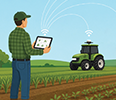 Vision4Ag: Computer Vision and Automation in Louisiana Agriculture
Ivan Grijalva, Saurav Upadhyaya, Michael J. Stout and Prashant Jha
The adoption of Internet of Things (IoT) applications in agriculture can help integrate interconnected sensors, devices and communication networks to continuously collect, transmit and analyze agricultural data in real time.
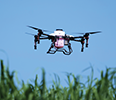 Sprayer Drone Operations in Louisiana and Future Precision Farming Aspects
Randy R. Price
Sprayer drones are relatively new tools used to spray inputs, such as pesticides or ripening agents, on crops. AgCenter researchers and Extension personnel are studying their flight characteristics, operational procedures and application patterns to make recommendations to a variety of agricultural producers.
Benita Komunjeru, Brian Gautreau and Kyle Peveto
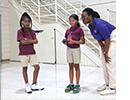
The LSU AgCenter Agricultural Career Exploration with Drones (ACED) program teaches young people about drones and geographic information systems to spark interest in agriculture, science and engineering through multiple educational streams.
Congliang Zhou, Zelin Qian, Brayden Blanchard, Niranjan Baisakh, Jim Wang and Andre Gama
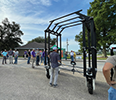
Researchers are combining high-tech tools to create a robotic system that can help crop breeders better assess their breeding lines.
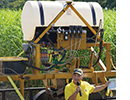 Development of VRT Can Allow Farmers to Cut Down on Costs, Potentially Improve Yield
Anthony Bailey
Variable rate technology, or VRT, has been developed and improved by LSU AgCenter researchers. Its primary purpose has been dispersing nitrogen fertilizer in sugarcane and rice fields, but researchers envision many more uses in the future.
Congliang Zhou, Zelin Qian, Matthew Foster, Connor Webster, Jeremy Hebert and Randy R. Price
Researchers are evaluating how artificial intelligence, drones and sensing technologies can improve weed detection and enable more precise herbicide applications, helping producers reduce costs while maintaining effective weed control.
Peng Fu
Advances in sensing technologies are allowing researchers to measure photosynthesis in new ways that were not previously possible, providing new opportunities to improve crop breeding, monitor crop growth and better understand agricultural productivity and water dynamics in Louisiana.
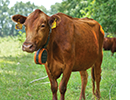 Virtual Fencing Technology Has Potential to Remove Sweat and Labor from Moving Cattle
Kyle Peveto
Virtual fencing collars aid cattle producers who follow regenerative agriculture techniques designed to maintain healthy pastures by rotating livestock regularly and allowing their grass to recover.
 AgCenter Researcher Using Animal Sensor Data to Understand Genetics, Health Issues
Kyle Peveto
In the fast-growing field of precision agriculture, researchers can take advantage of biometrics to help producers improve productivity. Shavahn Loux specializes in bioinformatics, a field where computer programming meets animal science.
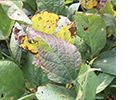 Characterizing Soybean Disease Risk Using Remote Sensing and Geographic Information Systems
Stephanie Ramos, Samuel Huayamabe, Sara Thomas-Sharma, Brenda Tubaña, David Moseley and Tri Setiyono
Satellite-based remote sensing provides an alternative approach to monitoring crop development across large areas by collecting repeated images of the same fields throughout the growing season.
Tri Setiyono, Aakriti Poudel, Carol Pinnell-Alison and David Moseley
Digital agriculture tools, such as sophisticated crop modeling software, satellite-based sensors and drone-based sensing technology, can help researchers improve their assessments of the impacts from weather events.
Nusrat Jahan, Michael Nii Attoh Agyiri, Frank Anyoka Adekilae, Parvin Momenian, Prashant Jha, Stacia Conger and Vinit Sehgal
The Louisiana Climate and Digital Agriculture Network is LSU AgCenter’s recently established statewide monitoring network designed to help farmers, Extension agents and researchers better understand the weather, soil and crop conditions affecting Louisiana agriculture.
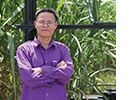 Congliang Zhou Aims to Connect Louisiana Producers with Artificial Intelligence, New Technologies
Kyle Peveto
Congliang Zhou joined the LSU AgCenter in 2024 to focus on precision agriculture, a strategy that uses data collected with new technologies, such as drones or robotic systems, to make agricultural operations more efficient.