Search
Allyson Martin, Carlton, Christopher E.

The hoary or pruinose squash bee is a ground-nesting bee found throughout most parts of the United States and Mexico. Female pruinose squash bees are slightly larger than males, reaching 12 mm to 15 mm in length versus 11 mm to 13 mm, respectively. Hoary squash bees may be mistaken for western honeybees (Apis mellifera) based on the yellow and black stripes on the abdomens, golden, fuzzy thoraces and similar sizes. However, squash bees belong to a different tribe, Eucerini (long-horned bees) and can be distinguished by their relatively long antennae and other, less obvious characters. Additionally, these bees have large eyes and a distinctively protruding face. Females possess extremely hairy pollen collecting structures (scopae) on the legs, hence the species epithet “pruinosa.” Males lack these structures because they do not collect pollen. Males can further be identified as having a small yellow patch between the eyes just above their mouthparts.
Eggs are similar in size and shape to small rice grains. Larvae are legless, fleshy grubs. Pupae are pale and resemble soft, compact versions of the adults with the appendages held close to the body. Immature stages are almost never seen unless dug up from their borrows.
The pruinose squash bee is also called the eastern cucurbit bee due to its highly specialized pollinator relationship with squash and pumpkins (Curcurbita). Genus placement varies among references, with some placing it in either Xenoglossa or Eucera.
Though many well-known bee species within the family Apidae are social and live in large colonies of related individuals such as bumblebees (Bombus spp.) and western honeybee (Apis mellifera), most members of the family are solitary. This includes the pruinose squash bee. Each female prepares a single burrow for brood care. These burrows may congregate in large numbers in suitable habitats near cucurbit host plants.
The hoary squash bee is univoltine (one generation annually). The life cycle corresponds to the phenology of cucurbits, typically squash or pumpkin in cultivated settings, so the exact timing of the cycle depends on the region. Each year in late August or September, mated females begin digging burrows in soil near squash or pumpkin plants. Within these nests, females lay a single generation of eggs. Larvae consume pollen provisioned by the adult females. The larvae mature into prepupae by the end of September and remain in this stage until the following June, approximately nine to 10 months. During May through July, prepupae molt into pupae. The pupal stage is brief, about three days. Adults emerge from the ground during early June in the southern U.S., including Louisiana, or as late as August in more northern parts of the range, depending on when squash and pumpkin crops begin flowering.
Newly emerged adults begin foraging for pollen and nectar, primarily from cucurbit flowers, but sometimes from other flowers. The consumption of pollen facilitates the development of ovaries within females, allowing them to mature. During this time, males and unmated females can often be found resting within wilted cucurbit flowers. Mating takes place on host plant flowers. Females only mate with one male, but males can mate with many females. By the end of August, mated females will complete burrow construction and egg laying for the next generation the following year.
Hoary squash bees depend on squash and pumpkin flowers as their source of pollen, so they provide valuable ecological services as highly specialized pollinators of these crops. Pollination services provided by squash bees are essential for the development of fruit. Other bee species, including non-native honeybees and native and non-native bumblebees, also pollinate squash and pumpkin flowers, but the hoary squash bee is a more efficient pollinator and avoids competition with other species by foraging early in the morning. Squash bees are found all over the U.S. and southern Canada, occurring wherever their cucurbit host plants are grown.
Recent research has demonstrated that populations of squash bees may be at risk due to certain farming practices, particularly tillage practices and insecticide applications. Squash and pumpkin farms that till their fields were shown to have squash bee populations only one-third the densities of farms that do not till. Additionally, increased use of neonicotinoid insecticides has been associated with reduced squash bee populations. Many other native bee species are at risk from a combination of pesticides and adverse competitive interactions with introduced species such as western honeybee and non-native bumblebees.
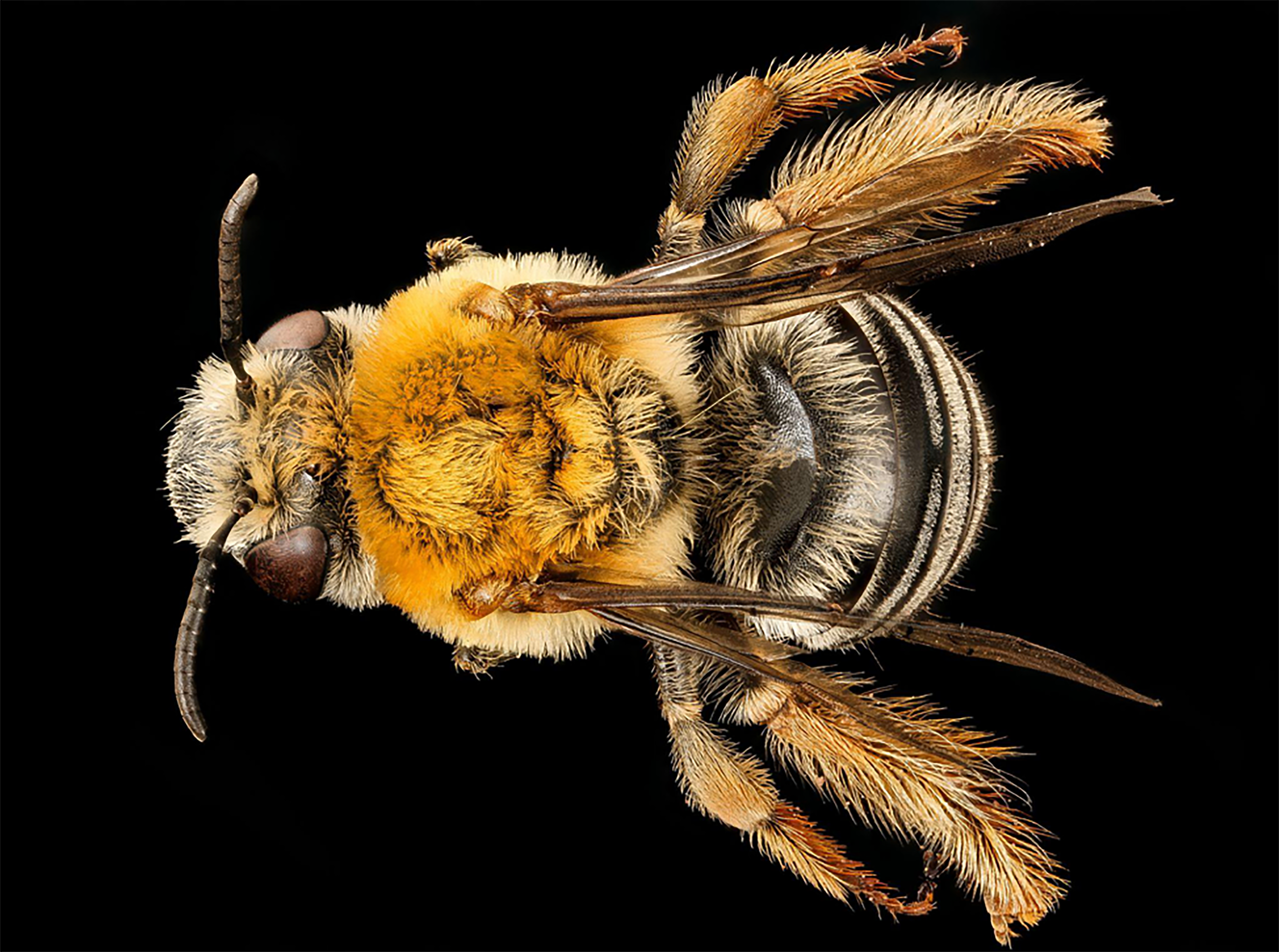
Dorsal view of a female pruinose squash bee. Photo by Sam Droege, U.S. Geological Survey Bee Inventory and Monitoring Lab

Anterior view of the head of a male pruinose squash bee, identifiable by the yellow spot between the eyes. Photo by Sam Droege, U.S. Geological Survey Bee Inventory and Monitoring Lab

Anterior view of the head of a female pruinose squash bee. Photo by Sam Droege, U.S. Geological Survey Bee Inventory and Monitoring Lab
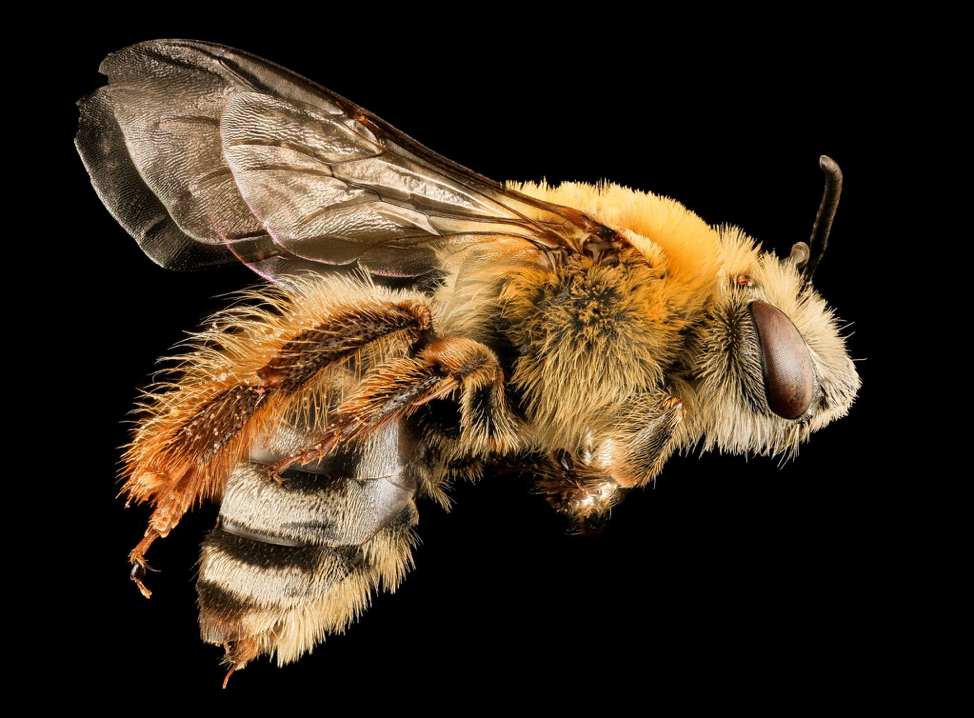
Lateral view of a female pruinose squash bee. Photo by Sam Droege, U.S. Geological Survey Bee Inventory and Monitoring Lab
Lopez-Uribe M.M., J.H. Cane, R.L. Minckley, and B.N. Danforth. 2016. Crop domestication facilitated rapid geographical expansion of a specialist pollinator, the squash bee Peponapis pruinosa. Proceedings of the Royal Society B 283: 20160443. (accessed 30 January 2026).
Owens, B.E., L. Allain, E.C. VanGorder, J.B. Bossart, and C.E. Carlton. 2018. The bees (Hymenoptera: Apoidea) of Louisiana: an updated, annotated checklist. Proceedings of the Entomological Society of Washington 120: 272-309.
Schuler, R.E., T.H. Roulston, and G.E. Farris. 2005. Farming practices influence wild pollinator populations on squash and pumpkin. Journal of Economic Entomology 98: 790-795.
Willis Chan, D.S., and N.E. Raine. 2021. Phenological synchrony between the hoary squash bee (Eucera pruinosa) and cultivated acorn squash (Cucurbita pepo) flowering is imperfect at a northern site. Current Research in Insect Science 1:100022. (accessed 30 January 2026).
Willis Chan, D.S., and N.E. Raine. 2021. Hoary squash bees (Eucera pruinosa: Hymenoptera: Apidae) provide abundant and reliable pollination services to Cucurbita Crops in Ontario (Canada). Environmental Entomology 50: 968–981.
Willis Chan, D.S., and N.E. Raine. 2021. Population decline in a ground-nesting solitary squash bee (Eucera pruinosa) following exposure to a neonicotinoid insecticide treated crop (Cucurbita pepo). Scientific Reports 11:4241. (accessed 30 January 2026).
Contact Us: For advice about pest identification or diagnosis, contact the LSU AgCenter Department of Entomology
P4091
10/19/26
The LSU AgCenter and LSU provide equal opportunities in programs and employment.